CAN AFRICA WORK IT OUT?
“Africa faces a difficult, possibly disastrous future unless it acts quickly to consolidate democracy, liberalise its economies, invest in people and infrastructure, and ensure the rule of law.”
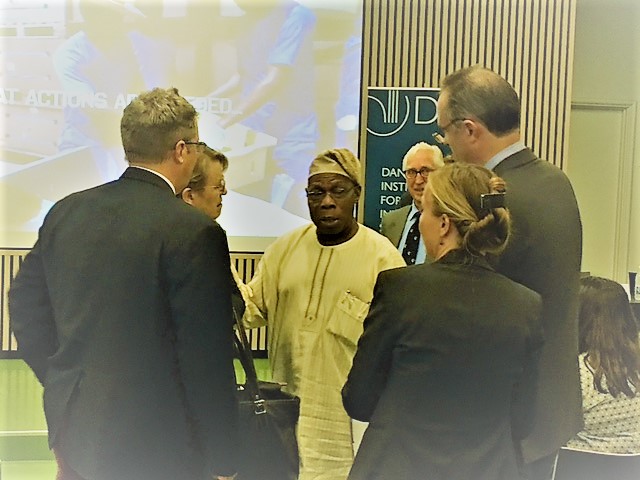
The book is written by the former Nigerian President, Olusegun Obasanjo, Greg Mills, Jeffrey Herbst and Dickie Davis, and it is intended as a first-hand account and handbook of how to ensure growth beyond commodities and create jobs in the continent. It has already been launched in many parts of Africa, and today the Danish Institute for International Studies [DIIS] hosted the launch in Denmark, with President Obasanjo, Mills and Davis participating.

This is not the first report or book which has tried what seems almost impossible: To define and design how leaders and citizens on the continent can create a prosperous future. But as stated by the authors at the DIIS seminar, in this book they have made an effort to focus on the key aspects, and Obasanjo asked the question: “Should it not be possible for African leaders to do a few things right?” Like fighting corruption, ensure rule of law and a predictable economic environment, which can attract much needed investment.
Hopefully the answer will be a forceful yes, it is possible! And this book is certainly helpful in many ways. One important aspect is the comparisons made with countries in East Asia, showing how countries in Africa and East Asia five decades ago were more or less at the same level of development – but today countries like Singapore, Indonesia and Vietnam have achieved a much higher income per capity, have developed much better infrastructure, created more jobs, and is attracting more investment from other countries. And as stated by Professor Holger Bernt Hansen in his comments, no jobs means no peace.
Former President Obasanjo left and Greg Mills to the right, at the launch at DIIS.
One area highlighted in the book is the democracy-development nexus. In his opening remarks, President Obasanjo emphasized that the two need to work together. People prefer to live in a democracy, and business needs a democratic environment. But it cannot be business as usual, because a different kind of Africa is needed. This requires leadership – and the question is if the leadership is ready to respond with force to the challenges lined up – in areas of agriculture, mining, manufacturing, services and technology, among others.
I certianly agree that democracy is important and necessary, but I am right now slightly less optimistic about the genuine nature of democratic leadership in many important Africa countries. Tanzania is actually rolling back on democracy. Ethiopia has managed to create economic growth without most institutions being truly democratic, just like it is the case in Rwanda under President Kagame. Present developments in South Africa can also reaise serious questions about the quality of democracy in this key country. Countries that have received much development aid from Denmark over the years like Uganda and Mozambique have also experienced shrinking space for democracy. Add to this list countries like South Sudan, Somalia, and DRC Congo that struggle with conflicts that seem to never end. The picture of Africa is slightly more gloomy than the book seems to indicate.
Another important aspect is the role of foreign aid in the future development of Africa. There is no separate chapter in the book about foreign aid, but investments and trade are seen to be more important. This does not come as a surprise to many of us, who have always seen the role of development cooperation to be, first of all, additional, catalytic and inspirational. The authors therefore also stated that donors, including Denmark, need to rethink how aid should be managed. If Africa needs to focus more on what is required right now, and try to do things differently and not as usual, then aid has to do the same.
It is rare that books have the power to change things overnight. I doubt that Making Africa Work is the ‘magic bullet’ some people might have been waiting for. However, I really hope leaders in Africa – and outside of Africa as well – will take the time to read it.